Tuesday, September 8, 2015

About Those Unicorns...

So last week’s entry was titled Lies, Damned Lies, Statistics About Planned Parenthood, and Unicorns. But I ran out of space to talk about the unicorns.

You’ll get them today.

But first there’s something very important I need to say before you get them.

I want you to forget the whole idea of conservatives waging an intentional “war on women” and their right to control their bodies. Even though that’s what it looks like from the other side, that’s not what they’re thinking at all. In fact, they’ll probably tell you that that’s not what they’re thinking.

And they’ll be telling the truth.

You see, what looks to many of us like a “war on women” is really the collateral damage of something that actually is important to them.

Morality. It’s the morality stupid.

Yes, I know that used properly, the term “morality” covers a lot of ground…including how we treat the poor and helpless among us. But for some reason, in popular…conservative…usage, it always gets down to sex. And when it gets down to sex, it gets down to none of it before you’re married. The Sexual Revolution may have happened back in the 60s, but these people are still fighting to have everyone maintain the moral standards of the 50s.

And at least, if people insist on not maintaining those moral standards, they shouldn’t have to help pay for enabling other people’s immorality with their tax money.

That’s what it gets down to. It’s not a war on women, it’s a war for “personal responsibility.” The problem is that women are unintentionally the victims of this war. They want “personal responsibility” for everyone equally, male and female. But it’s not their fault that when two people are being “immoral and irresponsible” only one gets pregnant.

And that’s why even if it didn’t deal with any abortions at all, many of these people would still fight to defund Planned Parenthood. It’s not personal. It’s not a vendetta against women.

It’s the morality, stupid.

And now here come the unicorns.

Aside from being the creatures that are so special that they will only approach a virgin, unicorns have been used as a metaphor for totally unrealistic, idealistic, expectations.

And the people who want to defund Planned Parenthood want their own unicorns.

You see, it’s been well established that the programs and services that Planned Parenthood provides help to reduce the number of unwanted pregnancies (thus keeping the number of potential abortions down) and reduce the number of people walking around with STIs. You’d think that everyone would like that. But the social conservatives argue that Planned Parenthood and similar organizations do this the wrong way…by enabling people to act immorally without suffering the consequences.

And to the sexual conservatives, as laudable as they are, reducing the number of unwanted pregnancies and STIs are only secondary goals. They’re secondary goals that are best met by focusing on their primary goal…abstinence before marriage.

The sexual conservatives want the unicorn of only teaching abstinence…even though it’s been shown that while abstinence is unarguably successful as a method, abstinence-only programs have an abysmal success rate. They want the unicorn of having everyone remain a virgin until they get married…even if they don’t get married for the first time until they’re 48.

They don’t want Planned Parenthood to be part of the game…with “their money”...because they want the unicorn of getting the results we all want the “right way.” And they don’t wan’t “their money” to enable people to keep behaving “immorally and irresponsibly” without suffering the repercusions.

They’re so focused on the idea of finding and riding that unicorn to the land of fewer unwanted pregnancies and STIs that they’re willing to walk past a whole herd of regular horses that can take them to the same place quickly.

But unicorns don’t exist. After all, if they did, their virgins would’ve been on them by now.

Tuesday, September 1, 2015

Lies, Damned Lies, Statistics About Planned Parenthood, and Unicorns


OK, today I want to talk about Planned Parenthood. And I want all of you...supporters, deriders, pro-choicers, and pro-lifers to sit down and listen carefully. Because I’m going to say a lot of things that neither side is going to like, but that is a lot closer to the truth than anyone has really been saying. And it’s a lot closer to the truth because it’s a lot more nuanced than the binary black/white, good/bad, pro-choice/pro-life version we’ve been getting, and have found ourselves forced to choose between.

But before I start, let me get this important piece of information out of the way: I’m pro-choice, but want to see as few abortions as possible. Pro-choice doesn’t mean that I believe that a woman should be able to have an abortion just because it’s Tuesday and she doesn’t feel like being pregnant anymore. It means that I recognize that there are some situations where what the Evangelical Lutheran Church in America calls on page 4 of its Social Statement on Abortion, the “option of last resort” needs to be safely there. I understand that there are some situations where there seems to truly be no good choice, no choice where there’s a clear “win” for either side.

Now, having gotten that out of the way, I’m going to start out with some commonly bandied about statistics, which for the sake of argument here, I’m going to assume are true. The first is that only 3% of the work that Planned Parenthood does is abortion related. Did you hear that? Only 3%. And yet, there are people who act as if that’s all they do and want to have it taken down for that reason. Why is that?

It’s because of the second statistic…which says that Planned Parenthood is the single largest provider of abortions in the United States. Let me repeat that again for emphasis: Planned Parenthood is the single largest provider of abortions in the United States. That doesn’t mean they do 99% of the abortions. It doesn’t even have to mean that they do 51% of them. They could do as little as 5% of the abortions in this country, if the other 95% was distributed among thousands of independent places that each did 0.1% or less. It just makes them the largest single provider.

It’s like this…since someone once called Planned Parenthood “the WalMart of the abortion industry”, let’s take a look at WalMart. They’re all over the place. You can hardly spit without hitting one. As a result, it’s pretty safe to assume that they may be the single largest seller of bicycles in the US. But is that all they sell? Not by a long shot. Is that the only place people go for bicycles. Not even. Do most people go there for bikes, or is that the place that most people go for bikes (two different things)? No and no. In fact, just recently we bought our bikes at Target.

Do you see what I’m getting at here?

So what percentage of abortions does this “single largest provider” perform? I’ve seen figures that say roughly 30%. This means that 70% of the abortions are being done by other people…that just aren’t as easily targeted.

Does everyone understand that it’s possible for all three sets of statistics to be true? Can the pro-lifers in the audience see that the defenders of Planned Parenthood are not being disingenuous when they say that abortion is only 3% of the work they do? Can the pro-choicers in the audience see why pro-lifers see Planned Parenthood as the “low hanging fruit” in their battle against abortion?

Can everyone see that it’s more complicated than the people on the extreme ends of the argument want to make it out to be?

And what about those unicorns?

Well…you’ll have to wait until next week for those.

Tuesday, August 25, 2015

Whose Privilege?

I remember the first time I heard the term white privilege. It was at a faculty in-service about diversity, back when I was still a teacher. I also remember my reaction when I first heard it:

It was a load of crap, because I was quite certain it was something else.

I had what I thought was a fairly middle-class upbringing. I knew people who had less money than we did and I knew people who had more money than we did. That meant that we were in the middle. We grew up in a two-family house with a dark and dusty cellar that had a coal furnace in it; but I also knew people who lived in single-family houses with finished basements.

We weren’t rich, but we didn’t want for anything, and had nothing to complain about. When we wanted bikes, we got them. When we wanted electric guitars, we got them. There were three TVs in our house: one in the living room, one in my sister’s room, and one in my room. That way we never had to fight over who got to watch what. We knew people who were teachers (a lot of teachers), lawyers, doctors, hairdressers, autoworkers, accountants, carpenters, retired military veterans, and who knows what all else. I had friends with swimming pools in their yards, and friends who had ponies at their birthday parties. There was one set of friends who had a large house out by the lake, and they hosted a cookout every year that brought in old friends from miles around.

All of these people were black. And all of these people instilled in us the idea that we could do anything we wanted…after all, just look at them. Yes, I knew there was prejudice out there, but big deal. These people succeeded, and so could I, if I had the right skills and a little bit of luck.

And because I knew I was middle class, and could succeed at anything I put my mind to, I didn’t have to prove myself to anyone.

But this wasn’t true for everyone.

I had a friend who didn’t feel the same confidence to succeed at whatever they tried at that the people I grew up with did, and who was always afraid of being found out to be “an impostor.” This friend’s family came from a working-class background, and when they made it to the middle class, and moved to the suburbs, it was total culture shock for her. She was always feeling that she wasn’t good enough, that she didn’t fit in, that she had to prove herself to everyone. Ironically, her family had more money than mine did, but she was comparing herself to a different batch of people than I was.

By comparing herself to what Elton John would call “sons of bankers, sons of lawyers,” she felt like she was poor and at a disadvantage to everyone else.

Even though she was white.

The thing was that I felt that I had more advantage than she did because I compared myself to different people. She was comparing herself to what I considered to be rich people…people that I felt it was pointless for me to compare myself to. And yet, because these were the people she grew up around…people with a few more advantages out the gate than she had, she felt that she was at the bottom of the pile. And when you feel that you’re at the bottom of the pile, it doesn’t matter whether or not you really are.

Similarly, when you feel that you’re middle-class, with all the rights and privileges thereunto pertaining, it doesn’t matter whether you’re black, white, or purple. If you feel it, you own it, have the self-confidence that goes with it, and are able to make things happen for yourself.

Based on how I now see white privilege defined, it’s undeniable that she had it. But no one defined it that way back then. In many very real terms, I did have more privilege than she did. And I did because I saw myself as being solidly middle-class, with no need to worry about what anyone else thought of me.

I had middle-class privilege.

And that’s a priceless thing that many people with so-called white privilege don’t have.


Tuesday, August 18, 2015

The Mixed Signals Our Symbols Send


Over the past few months I’ve had the opportunity to think about some of our symbols, and what they say about us. About how we see them and how others see them. About what we think they say about us and what others think they say about us. About the message we think they send and about the message that others think they send.

So with that in mind, I want to talk about a symbol that is beloved by millions, but causes hard feelings among a small minority of people in this country.

It’s the cross.

Yes…the cross. Be it a plain, empty, Protestant cross or a fully-loaded Catholic crucifix.

To Christians, the cross is a symbol of love. A symbol of God’s love that he would be willing to come down to earth, live among us, and die one of the most painful deaths imaginable for our sakes.

But to many Jews, it’s a symbol of hate. It’s a sign of a religion which was responsible for a lot of anti-Semitism. For many in the LGBT community, it’s the symbol of a religion which is responsible for a lot of hatred against them as well. And for many who are non-religious, it’s the symbol of a group of people who are arrogant, ignorant, small-minded, mean-spirited, and want to force everyone to live by their rules.

So which is it?

Technically speaking, the cross in its Christian usage is supposed to be a symbol of love. But it’s undeniable that over the past 2000 years, Christians have not been entirely loving of others. It’s true that we’ve been responsible for some pretty horrible things and that the writings of some Christians have been used to justify some pretty horrible things. So which is it, a symbol of love or a symbol of hate? More to the point, is it intrinsically a symbol of hate, or has it unfortunately been hijacked and turned into one by people who didn’t quite grasp its true meaning?

When those of us who are practicing Christians say that the cross is a symbol of love, and not of hatred, are we supposed to expect those who have suffered at the hands of people who carried it to buy it?

Really?

All of which brings me to the symbol you probably thought I was going to talk about in the first place…the Confederate Flag…or more precisely, the Confederate Battle Flag.

There are those who say that it’s about “heritage, not hatred,” and that it represents their part of the country. There are others who point to the founding documents of the Confederacy and the reasons behind the designs of the first flags as undeniable evidence that the Confederacy was founded on racist principles, and to preserve slavery in the South.

And yet…there are others who point out that fewer than 10% of Southerners owned slaves, and that the average person wearing a gray uniform was fighting to protect their land, and to prevent the Yankees from telling them what to do.

Is it possible that the average Southern farm boy who put on a gray uniform had no idea what was going on at the highest political levels, and didn’t know the totally racist agenda behind secession? And is it possible that most Southerners have never heard of those documents or what’s in them?

Yes.

And…if they don’t know what’s in those documents, then can they legitimately say that to them it’s about “heritage, not hatred”, without needing a stiff laxative…despite what historians say?

Yes.

And yet…as with the cross…should they expect those who have suffered at the hands of people bearing that flag to buy it…especially when they know its history?

I’ll let you think about that.

Tuesday, August 11, 2015

20 Women, 200 Dates, and a Little Math

Two weeks ago I cited two well-known statistics to you. Well, at least they’re well-known to me. The first was:

1 in 5 women will be the victim of some sort of sexual assault.

The second one, from my 19 years of teaching, was:

5% of the students cause 95% of the problems.

I also said that the first statistic did not necessarily imply that 20% of all sexual encounters between women and men involved some sort of assault.

Today is where I show you how that works, by looking at 20 women and 200 dates.

Now before I start out, let me just say that the information I present here is not going to be done to the same rigorous standards that it would be if it were done by a certain statistician I know, but it should be enough to make my point.

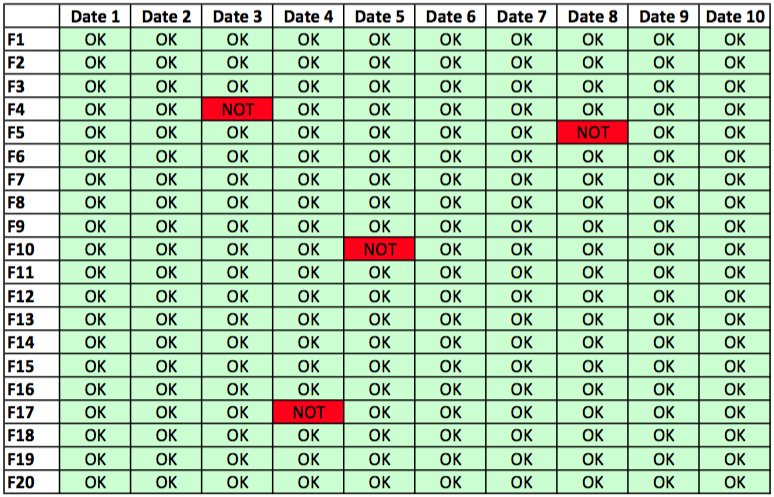
We’re going to start off with a set of 20 women, labled F1 through F20, and have them each go out with 10 men over the course of a number of years, thus giving us a total of 200 dates. The 10 men each woman goes out with may or may not be from the same set, since people move around a lot. This means that there could be as many as 200 different men involved or there could be some overlap. It really doesn’t matter.

What does matter is that 5% of the up to 200 different guys are assholes who don’t know the meaning of the word “no”, and that they will cause problems for four of the 20 women. With 200 dates, that means that a chart of the women and dates would look like the one below:


So while 20% of the women have dealt with some form of sexual assault on a date, 96% of the dates…and possibly guys…are just fine.

Now let’s take a look at what the statistic isn’t saying, but could easily be misunderstood to mean. It most definitely is not saying that 20% of all dates go horribly wrong. If that were true, then the chart would look like this one:


Now, notice that even though one fifth of all dates here ended up with some sort of assault, the assaults weren’t evenly distributed. F1 only had one date that resulted in an assault, and F17 got off scot free. On the other hand, F20 was a very unlucky woman.

So now that we know what it is and what it isn’t, we’re faced with two possibly conflicting sets of statistics: The first says that 20% of all women will have to deal with an incident of sexual assault. The second says that 96% of all dates are just fine.

If you’re a woman, which set of stats should you let guide your life?

As a person who knows that flying is statistically the safest way to fly, but whose favorite airline is Amtrak, and hasn't flown since 1987, I don’t really have an answer to that.

Tuesday, August 4, 2015

The $20 Question

Last week I said that I had two responses to New York’s new “Yes Means Yes” rule, but only had room to give you one. This week I’ll give you the second.

This is that far from “protecting women from unwanted advances”, it totally ignores the fact that women are often the ones making advances…and often on guys who are too clueless to realize that an invitation is being offered. It forgets that the 60s and 70s happened, when women felt as free to pursue as guys…and were just as likely to see how far they could get…or get the guy to go.

With that in mind, I offer an embarrassing experience of mine.

A girl I knew back in the mid-70s had taken a $20 bill from me and stuffed it down her blouse. And $20, as I found out when I went to the online inflation calculator was a lot of money for a teenager back then…almost $100 in today’s money.

Being a gentleman, and liking my dental work exactly as it was at the moment, I politely asked her to give it back. She smiled and refused. I asked again, and with a twinkle in her eye, she smiled and refused again. Finally, after I begged her to give me back my money, she gave me a disgusted and disappointed look, reached in and got out the $20, and threw it at me.

I understand now that this was a non-verbal invitation to “go there.” However, under the new “Yes Means Yes” rules, this non-verbal invitation wouldn’t be enough. I’d have to ask, “May I stick my hand down your blouse to get my money back?” And her replying, with a twinkle in her eye and a lilt in her voice, “What do you think?” would not be considered an “active and enthusiastic ‘yes’.”

And…if while I was naively and single-mindedly trying to get my $20 back without doing anything I didn’t think I was supposed to, she pressed herself close to me in order to force the issue, and maybe finally have the little light go on over my head; because it was non-verbal, it still wouldn’t count as an “active and enthusiastic ‘yes’.”

Even though 99% of us would know what she was implying should happen.

So, should a guy in that position finally decide that this was an invitation to proceed, under the new rules, the Sex Police would pull him over and cite him with a violation.

Don’t get me wrong…I’m a big believer in consent…for both parties. But consent is so very often non-verbal. Flirting and making out are so often based on non-verbal cues or on indirect invitations that don’t exactly spell everything out. Just check out these examples of guys who missed the boat, and the girls who tried to invite them aboard, and you’ll not only see that, but you’ll see that most guys aren’t looking to force themselves on a girl.

Romance is messy. Relationships, and especially sexual relationships, have a lot of gray areas and a lot of non-verbal communication involved. These are communication skills which need to be learned eventually.

And a simplistic “Yes Means Yes” rule doesn’t help that at all.

Finally, next week I'll explain why the combination of 20% of all women and 5% of all men doesn't add up to 20% of all male/female encounters.

Tuesday, July 28, 2015

Mother, May I?

Last week I talked about Cosby, Consent, and Cricket. There was more I wanted to say on the issue of consent, but I really wanted to keep the piece down to about 600 words; so I decided to break my thoughts up into two pieces.

This is the second piece.

Let me begin with two oft-cited statistics, which may or may not have any solid basis in fact. The first is one that is very pertinent to the discussion of consent:

1 in 5 women will be the victim of some sort of sexual assault.

Now one from my 19 years of teaching:

5% of the students cause 95% of the problems.

What does this mean? Far from meaning that 20% of all guys are assholes, it means the 5% who are, are causing all the problems, messing up the lives of millions of women, and giving the rest of us guys a bad name.

And let's examine that first statistic one more time. It's not saying that 20% of all sexual encounters a woman has is some sort of assault. That's something completely different. But maybe we'll talk about that math some other time.

Besides, that’s not what I want to talk about yet. I want to get back to talking about consent.

…and overreacting.

It used to be that the catchphrase was “No Means No.” That was enough for 95% of us. We got it. Of course, there were a few “maybes” in there that got people confused and caused a lot of trouble…a lot of what one friend once called “felony stupidity”, but for the most part, we got it.

But some people didn’t, and as a result, New York is the latest state to enact a “Yes Means Yes” law. This law means that “She didn’t say ‘no’,” isn’t enough. There has to be an active and enthusiastic “Yes!” “Well, OK” doesn’t cut it. Not even a “Well OK” with a twinkle in her eye that would seem to indicate that this was where she wanted things to end up in the first place. There has to be an active and enthusiastic “Yes” at each step of making out.

My response to this is twofold. The first is: You gotta be kidding me! Instead of two people making out and negotiating non-verbally what they want to do as they go along, this turns everything into the following rather unromantic game of “Mother May I?”

Pat: May I kiss you?

Chris: Yes.

Pat: May I kiss you again?

Chris: Yes.

Pat: May I put my hand on your butt?

Chris: Yes.

Pat: May I unbutton your shirt?

Chris: Yes.

Pat: May I undo your pants?

Chris: Yes.

You will notice that I didn’t state what sex either Pat or Chris were. Either one could be male…or female…or they could both be male…or female. It’s not always a case of the guy putting the moves on the girl.

This new rule puts what has traditionally been an improvised dance, with nonverbal cues being understood by most people, into a game of legal contract. 95% of the guys out there understand that if you try to unzip a girl’s pants and she gently moves your hand away, then you should stop. They also understand that if she responds by unzipping yours, then you can try to move further. And the key word here is “try.” If at any point she brushes your hand away, you know not to try again.

But because of the 5% of guys who wouldn’t understand “No” if they were hit over the head with an anvil with the words painted all over it, a new rule has been put in place that says that everyone has to play “Mother May I?”

As for my second response…well, since I’m running out of room again, you’ll just have to wait another week for that.